
Growing Malta's trees in Minecraft
How I gave Malta in Minecraft 16 real Maltese tree species, placed them where real trees stand, and what went wrong on the way.
In short: Vanilla Minecraft has no carob, no olive and no għargħar, so I wrote a tree generator with a recipe for each of 16 Maltese species. Each tree stands where survey data says a tree stands, and its species comes from the place it grows: field walls, valleys, woods or the shore. It took eight olive colour tests, a prickly pear that looked like a pile of leaves, a rule with no evidence behind it and a height survey that showed my woods were 1.5 to 3 times too dense.
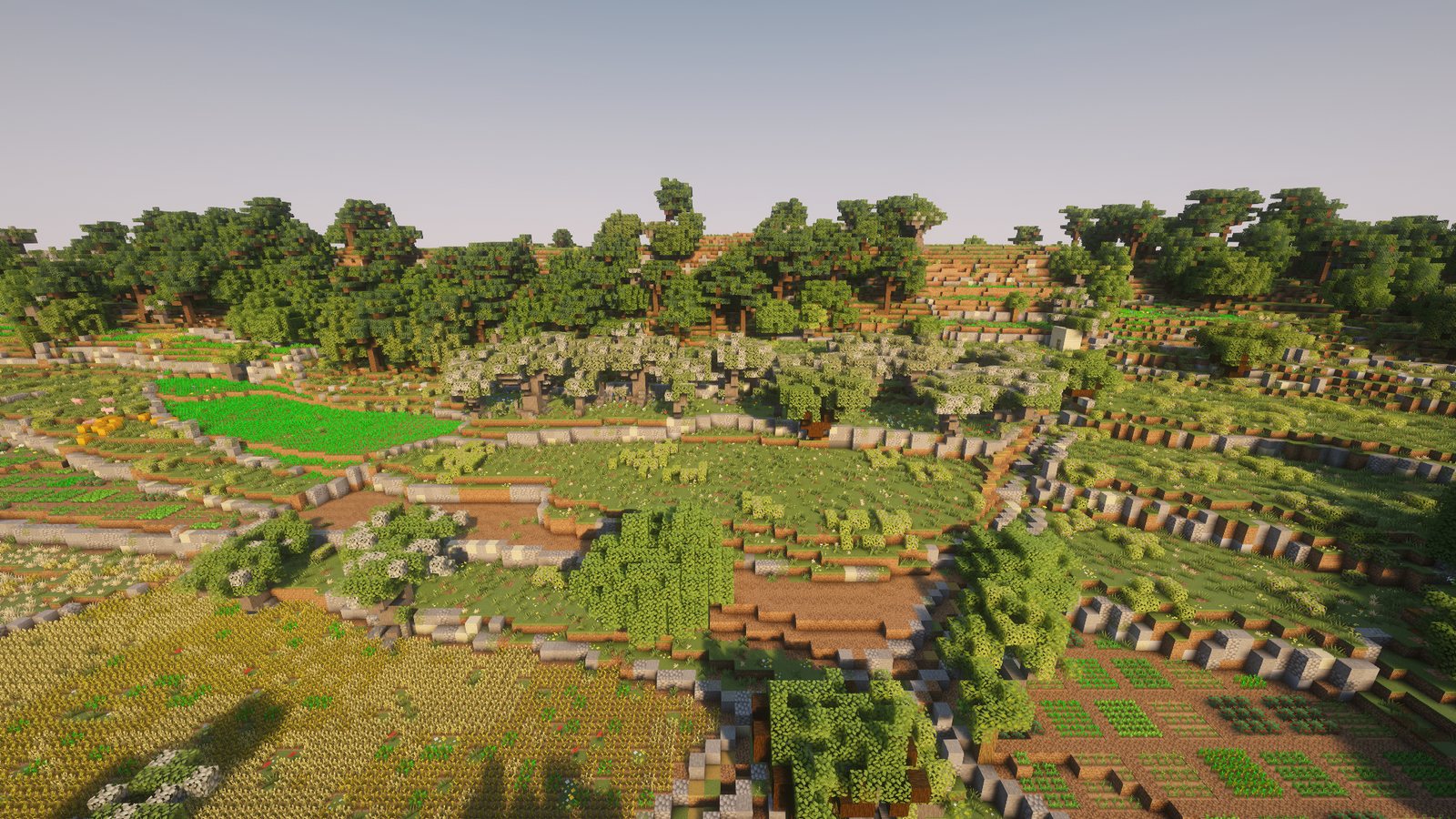
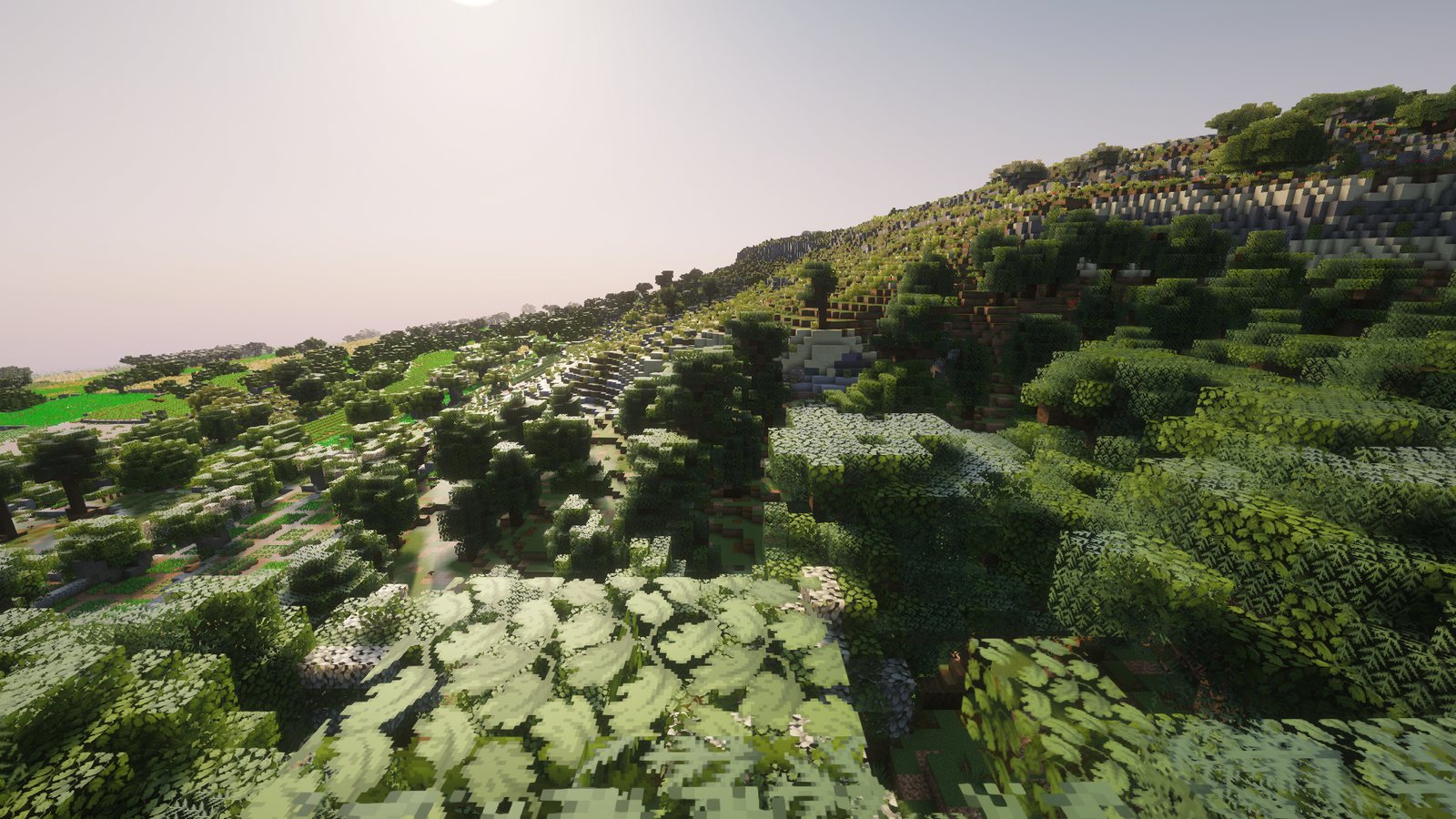
On a Maltese hillside, carobs crouch under the terrace walls, grey olives stand in rows and tamarisks lean away from the sea. Vanilla Minecraft's oak, birch and spruce look nothing like them. This post tells how I built the Maltese ones, where they grow and what I got wrong. The finished species are on the wiki: Trees.
Finding out what grows where
The "where" came from a satellite land cover map that marks every 10 m square with tree cover (Zanaga et al., 2022). It shows about 2,886 hectares of trees on the islands: 2,352 on Malta and 534 on Gozo and Comino. More than a third is on farmland and only about 5 % in real woods.
The "which" came from reading. Haslam (2001) found that most Maltese hedges are fruit trees beside the field walls: almond, carob, fig, olive, pomegranate and vine, plus prickly pear. Valley sides hold carob, olive, lentisk and bay laurel. Buskett and Wied il-Miżieb have planted Aleppo pine and old holm oaks. Tamarisks grow by salt marshes and bays. OpenStreetMap has 2,712 single trees, and almost none of them name a species.
That gave me the rule the whole system still uses: the data says where a tree stands, and the place decides what kind it is. A tree on a field wall is carob 30 % of the time, olive 22 %, almond 18 %, fig 18 %, citrus 7 % and prickly pear 5 %. A tree in a pine wood is almost always a pine.
A recipe for each species
I gave each species its own recipe in three sizes: young, mature and old. The first round had 11 species, and the first gallery showed plenty of problems. Pines were too thin, figs and almonds looked like a wedge under a disc, olive leaves were too grey and the tamarisk was tiny and red.
The prickly pear
My first prickly pear was a stack of moss cubes with a flower on top. In the game it read as random leaves with a flower.
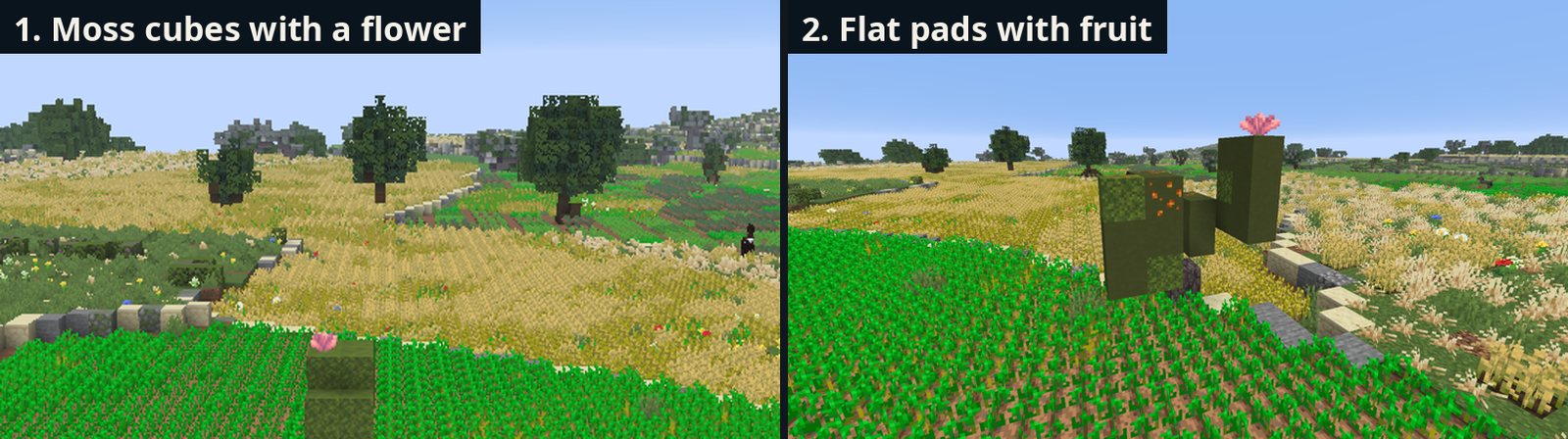
The fix was to build it the way the plant grows. Each pad is one block thick and grows from the top edge of the pad below, either turned across it or set one block forward or back, so the pads never merge into one slab. Resin clumps make the orange fruit on the pad edges, and old plants stand on a short woody stem.
The olive
The olive took the most tries. My first version had pale oak leaves, and in the game it looked like a weeping willow. I made a test row of eight olives, A to H, each with a different bark and leaf mix. Acacia bark came closest to the smooth grey of a real olive trunk. A second round tried four leaf mixes and seven base materials, and the winner was 70 % oak leaves with 30 % pale oak, a crown 20 % airier than the other species, and grey tuff around the foot.
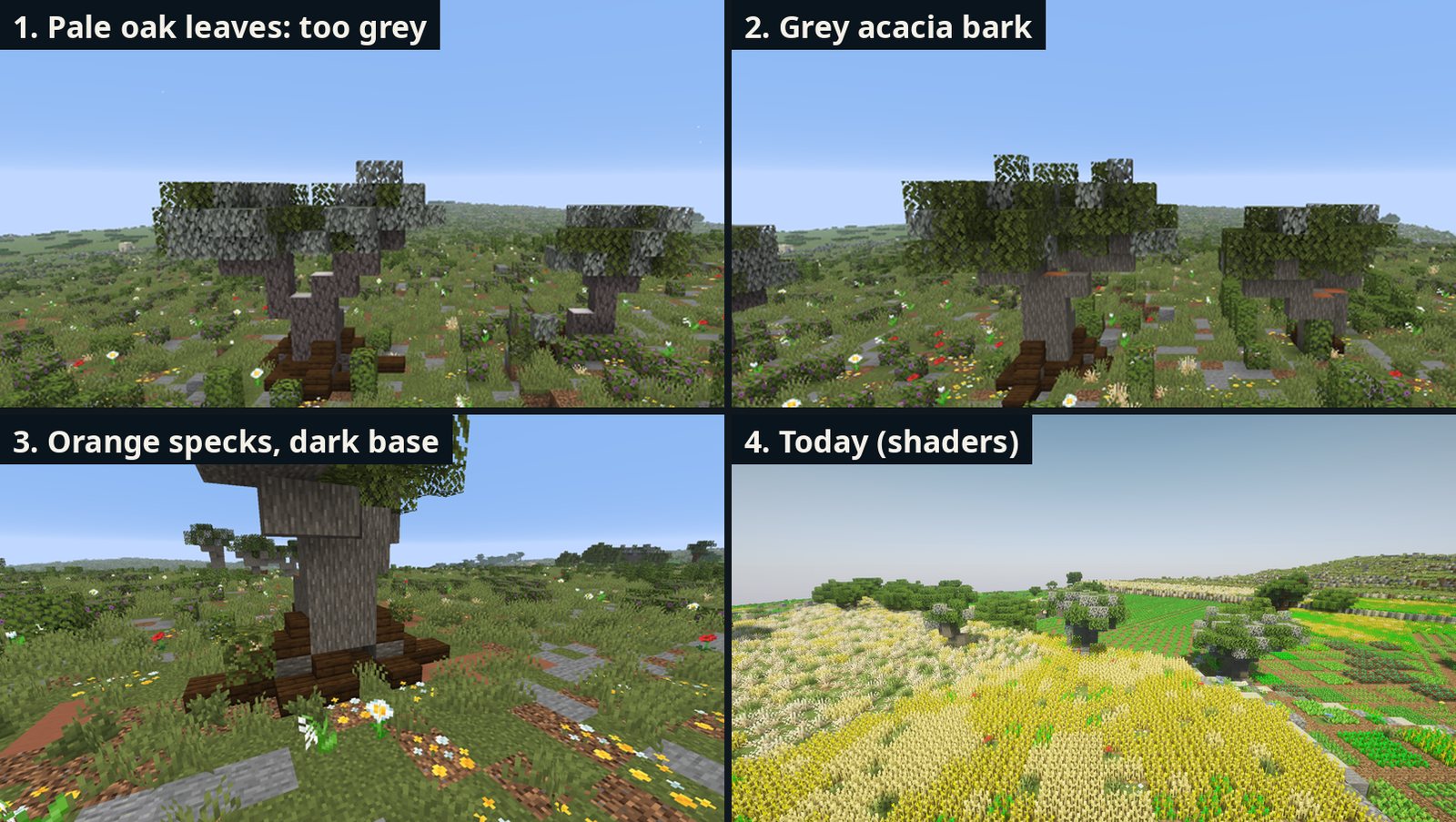
That round showed a new bug. Acacia logs have orange ends, so wherever a trunk stepped sideways, an orange speck showed on top. Oak, spruce and dark oak showed plank-coloured rings in the same places. I switched every trunk, branch and root on all species to the bark-on-all-sides wood block, then scanned the test world block by block. None of my trees had a log left.
Bark, roots and feet
Several species shared one wood, so I gave each a matching bark. Carob got mangrove bark, which is grey-brown. Pine and tamarisk got poplar, a warm reddish brown. Almond got spruce, with cherry on about one in five. Olive and fig got acacia, and holm oak and lentisk got dark oak.
My first tree bases had stairs leaning on every side of the trunk, with slabs in the corners. They looked even and artificial. Now each tree builds its own foot: roots on one to four sides, one side heavier, a mix of stairs, bark knees and slabs, and root runners that wander off sideways and end in a slab.
More species
Five more species brought the total to 16. Palms went into gardens. White poplar is birch wood with a narrow oval crown, and it grows on the valley floors at Wied il-Luq and Chadwick Lakes. Eucalyptus has peeling, partly stripped birch bark and makes up a quarter of the trees in Ta' Qali park.
My first eucalyptus rule also put it on 35 % of trees beside any reservoir. When I checked, I found no source for it. The Chadwick Lakes (n.d.) species list has white poplar, ash and willow, and no eucalyptus. The rule had never even run, because the poplar rule took those trees first. I dropped it and added the trees that do grow there: white willow and narrow-leaved ash.
The national tree
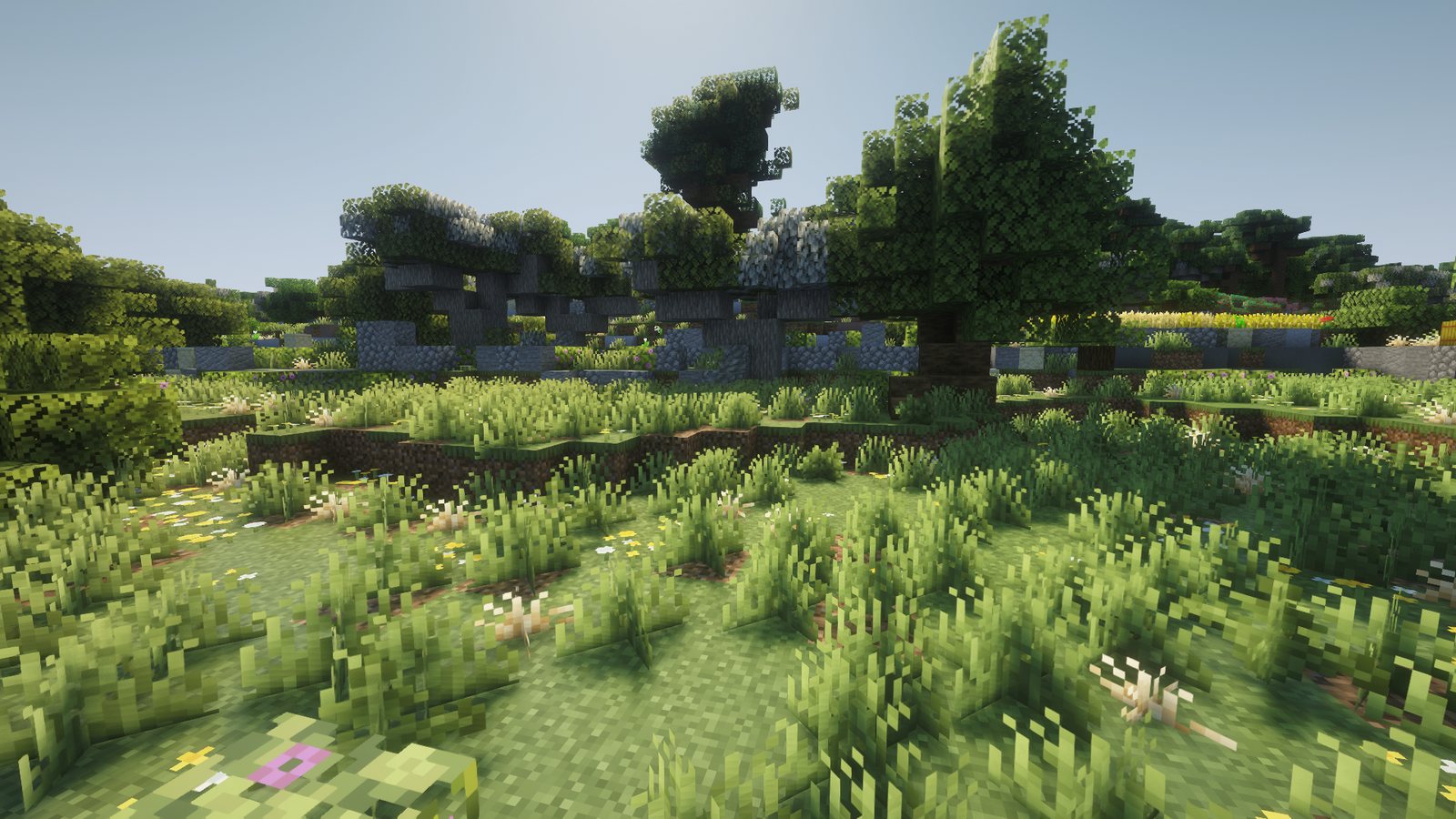
The għargħar is Malta's national tree, and fewer than 130 mature wild ones are known (Sánchez Gómez et al., 2019). About 100 grow at Ta' Pennellu, at the head of Wied il-Miżieb. The rest stand alone or in small groups, such as one by the chapel at San Ġużepp tat-Targa and one on the floor of il-Maqluba.
I traced the Ta' Pennellu stand from the dark canopy on the 2018 aerial photo. It is 0.9 hectares and holds 146 tree positions from the data. 68 % of them are għargħar, so about 100, and the rest are carob and olive. The għargħar recipe is a dark, upright, ragged cone. Old ones have two or three stems sprouting from the base. The single trees at the smaller sites are placed near the named places. They are my estimates, not surveyed trees.
Tamarisks and the wind
The tamarisk took three rounds. The second round bent the crowns inland, away from the nearest coast. Then I found a tamarisk lying on the ground like a fallen log. The ground rose downwind there, so the bent trunk ran into the slope. The trunk also had an upright foot and then a sharp elbow, and real tamarisks bend at an almost steady angle all the way up.
The third version leans one to three trunks at a steady angle, with a feathery dome on top. If a trunk would come within about 2 blocks of the ground, the tree grows as a bush instead, with many stems and a skirt of sprays to the ground.
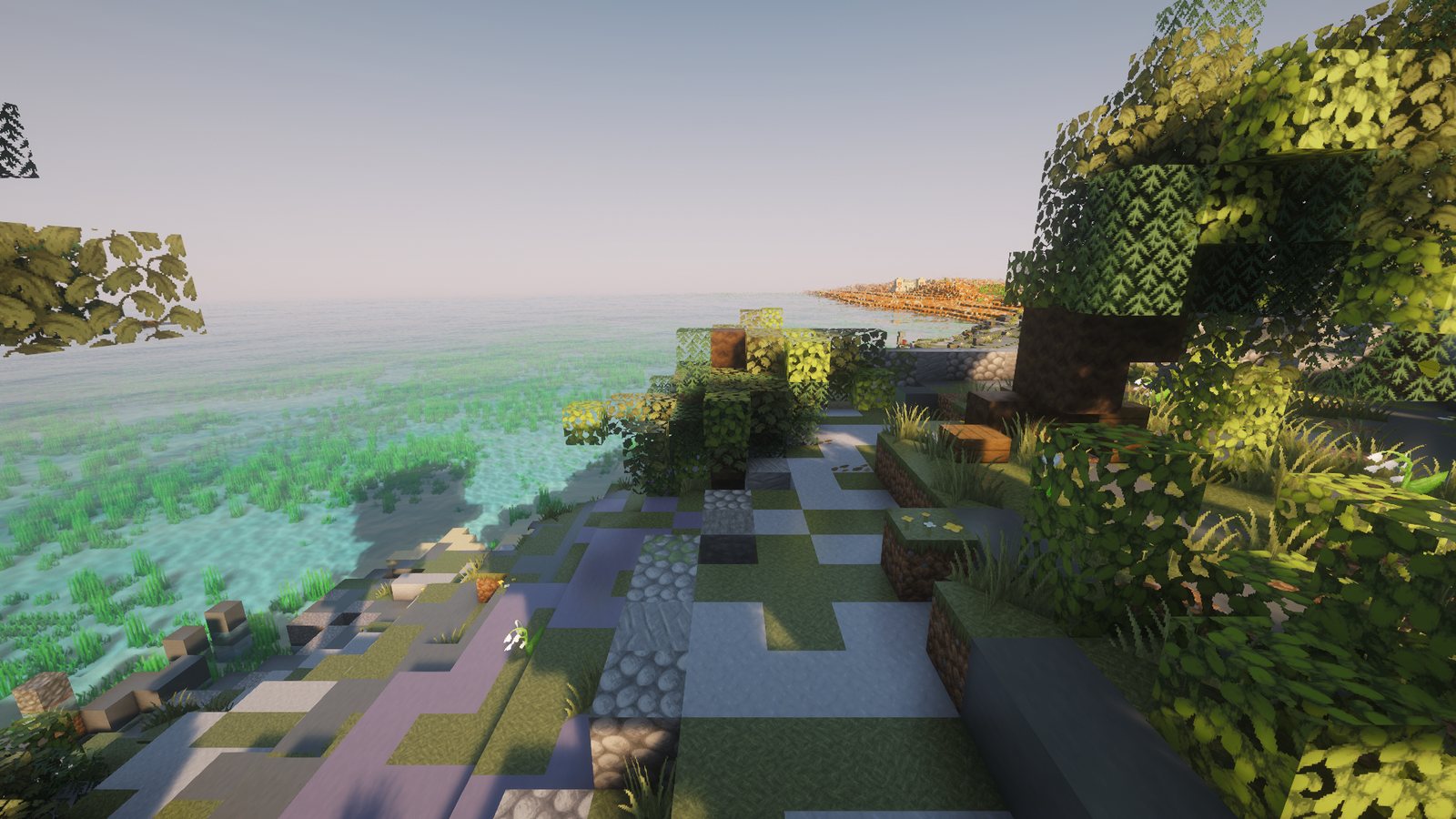
Then all trees got a wind rule. Height alone doesn't work on Gozo, because 71 % of its tree spots stand above 60 m. I worked out an exposure score from how open each spot is to the north-west, whether it sits on a ridge or in a hollow, its height, and open sea upwind. On Gozo, 42 % of spots are sheltered, 30 % light and 27 % strong. The species that bend most in reality bend most in the game: tamarisk and Aleppo pine lean hardest, olives get a lopsided crown, and carobs barely move.
Trees in the right places
Farmland
I spotted trees standing in the middle of fields and in rows across them. I checked, and both problems were real. 30 to 48 % of the satellite-map trees on worked fields stood 3 m or more inside the field, and up to 55 % of the wall trees stood under 1-block terrace steps that read as rows from above. Wall trees now grow only along walls and under steps of 2 blocks or more, and a tree inside a field moves to the nearest edge unless it belongs to a real copse.
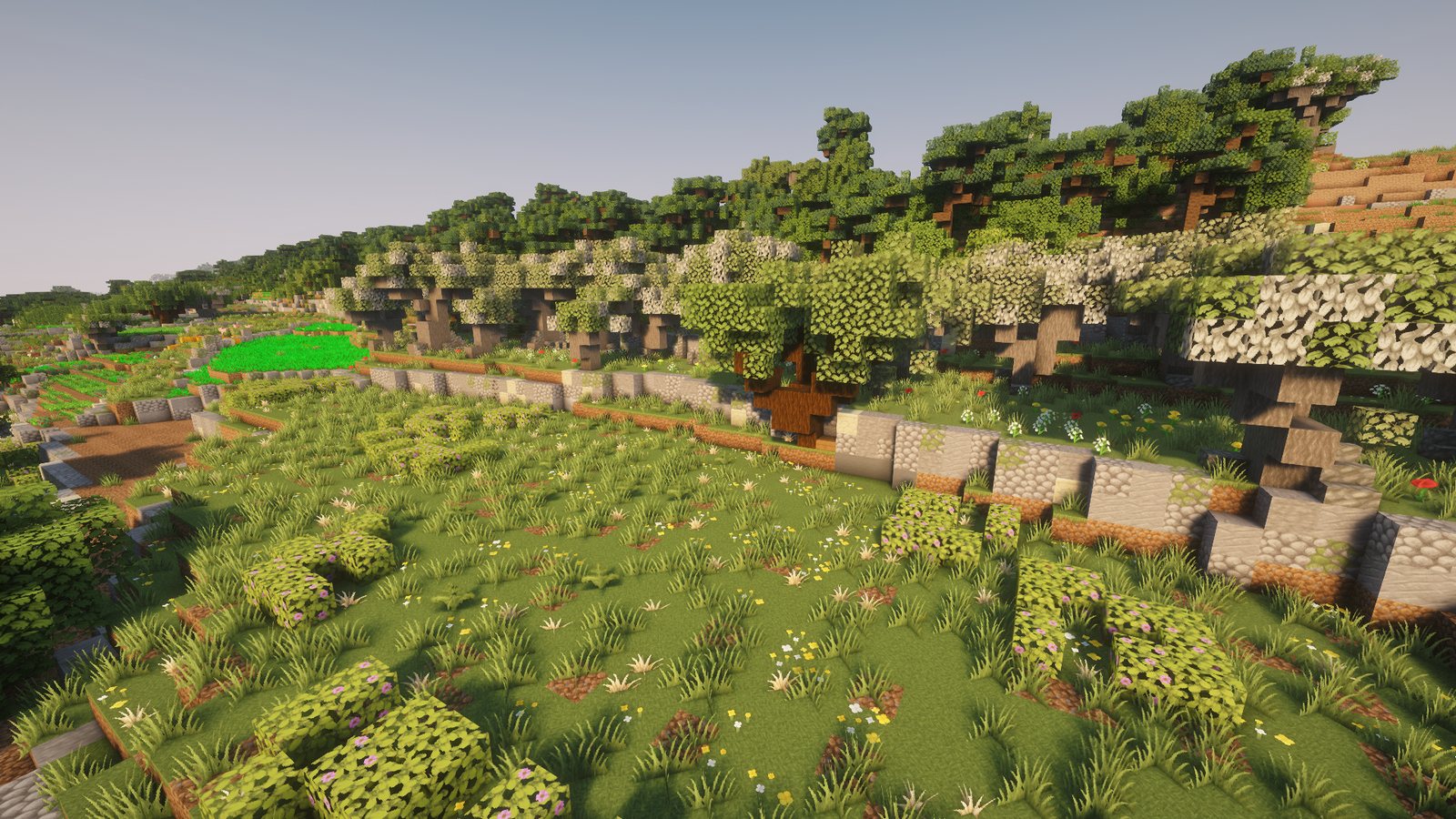
Later I found the real tree crowns on the 15 cm aerial photo, and on farmland each crown now gets one tree. The first try also turned the shadows of terrace walls into rows of trees, so long, thin, even dark strips are now thrown out.
The woods
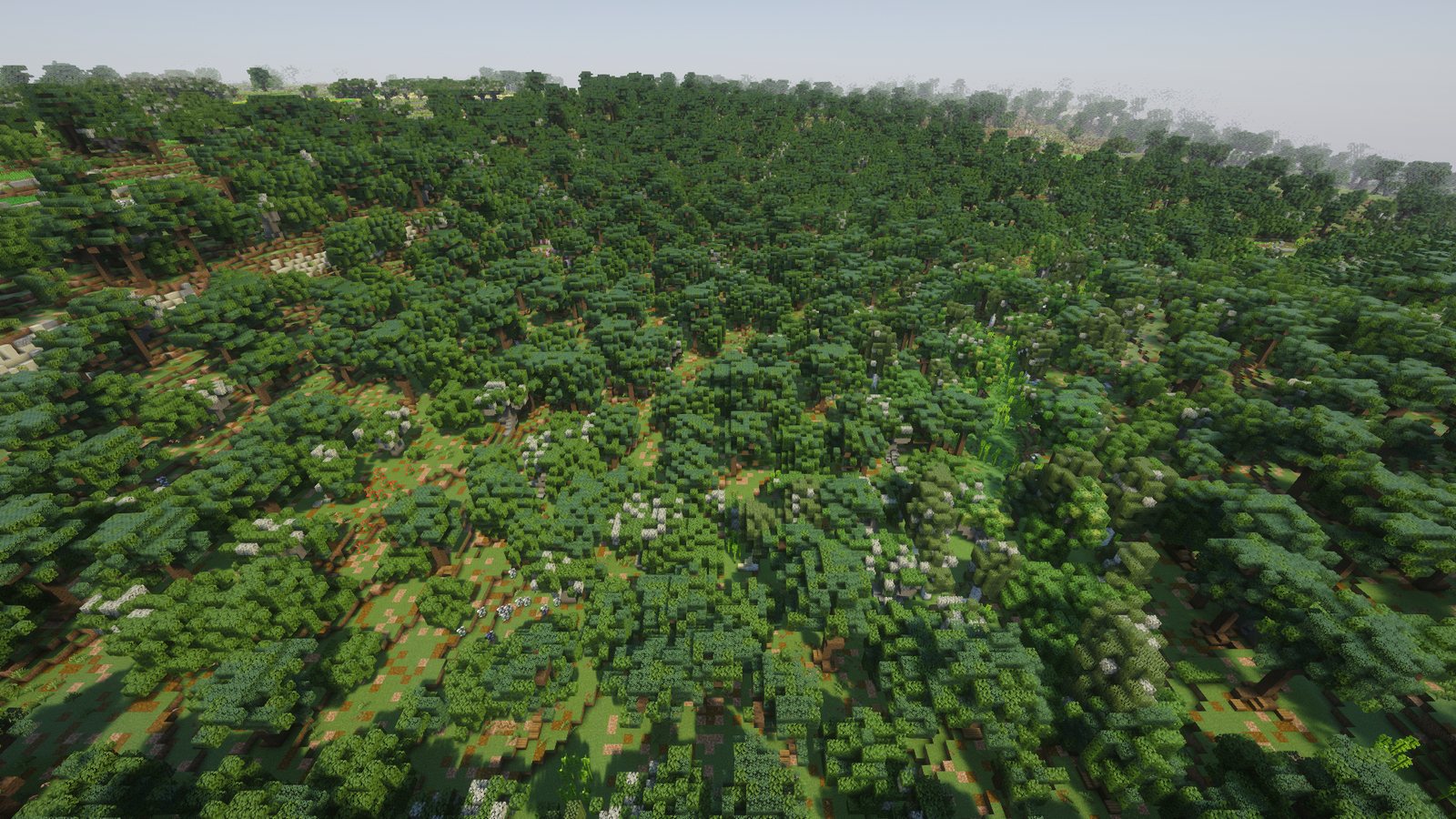
My woods looked like one dark carpet. Trunks stood about 4.5 m apart, but carob and holm oak crowns spread 4 to 6 m. I made each crown stop part way towards its nearest neighbour, so the light gets in and the trunks show.
Then I checked the trees against the 2018 surface survey, which measures the height of everything from the air. The game had 1.5 to 3 times as many trees as reality on every site I tested, and it filled real clearings and paths with trees.
So I rebuilt the woods from the survey heights. Trunks go on the real tree tops, highest first, sized from the real height, and no tree grows where the ground is open. I checked it at 15 woods. The share of ground that is right (leaves where real trees are, open where the real ground is open) went from 48–58 % to 72–87 % at every site.
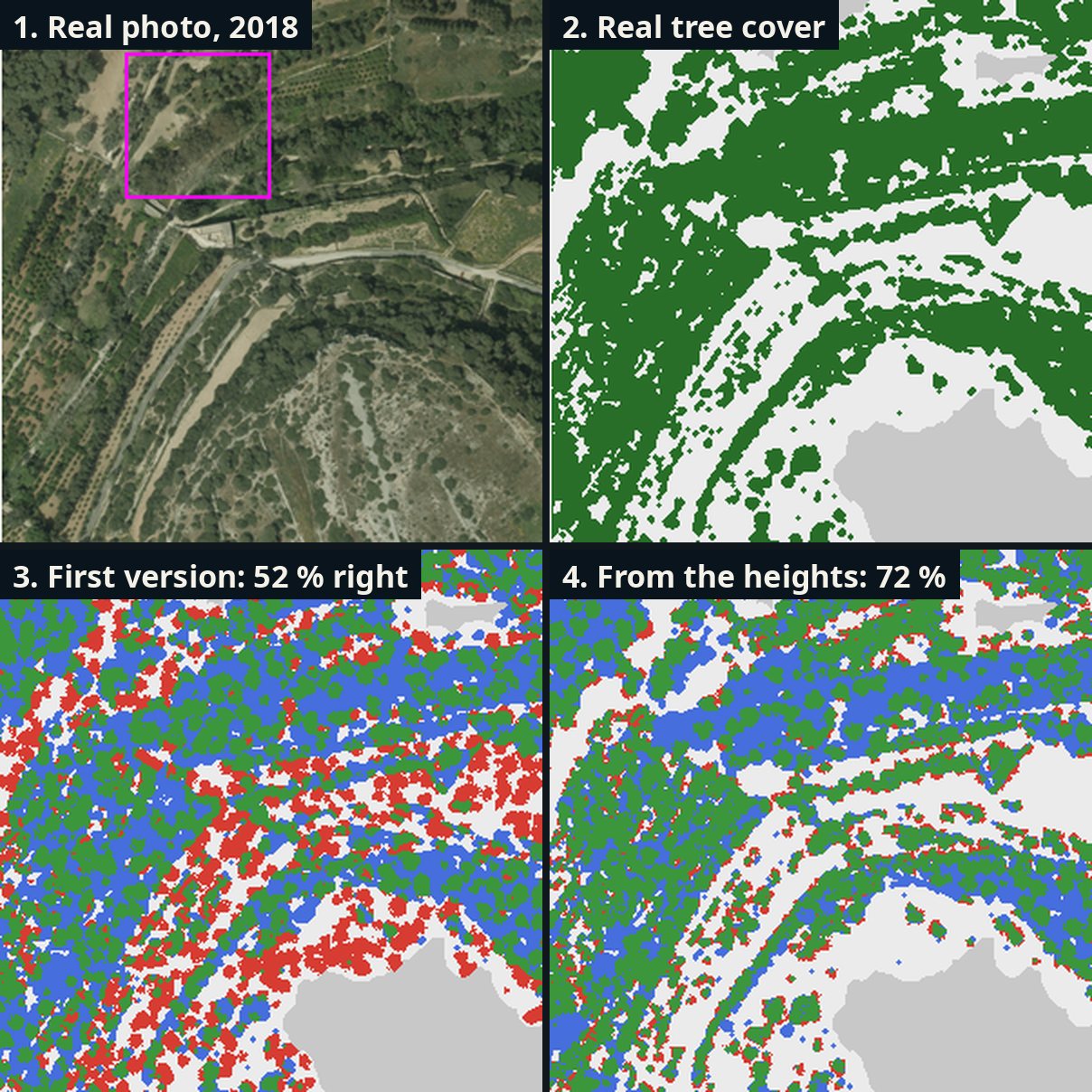
That check also showed a bug. In dense woods up to 16 % of tree spots were empty, because a neighbour's leaf litter or a mushroom on the spot stopped the trunk from growing. Small plants are now cleared first.
The wood rebuild is switched on for the next build of the islands. The current world still has the earlier woods.
What it taught
- The place decides the species. The setting nearly always tells you which tree it is.
- Every rule needs a source. The eucalyptus rule sounded right and had nothing behind it.
- Check against real measurements. My woods looked fine until the survey heights showed they were far denser than the real ones.
- Small blocks matter. One orange speck on a log end is enough to break the look.
Every species has a wiki page, starting from Trees and Għargħar. Do you know a special tree on the islands, or have photos of one? Get in touch.
Technical details
- Positions: WorldCover tree cover (Zanaga et al., 2022); crowns from the Planning Authority's 2018 aerial photo (15 cm) on farmland; in woods, trunks on 2018 canopy height of at least 2 m, no two closer than 0.7 × crown width (1.7 m + 0.75 × height).
- Crowns: reach 0.6 × the distance to the nearest trunk + 1 block.
- Wind: openness to the north-west (45 %), ridge or hollow (25 %), height (20 %), open sea upwind (10 %).
- Pictures: Complementary Unbound shaders and Faithful 64x. Stage pictures come from earlier test worlds without shaders.
References
Chadwick Lakes. (n.d.). Biodiversity. Retrieved October 24, 2026, from https://chadwicklakes.mt/biodiversity
Haslam, S. M. (2001). The cropped walls of Malta. In C. J. Barr & S. Petit (Eds.), Hedgerows of the world: Their ecological functions in different landscapes (pp. 87–92). International Association for Landscape Ecology (UK). https://www.um.edu.mt/library/oar/handle/123456789/5166
Sánchez Gómez, P., Stevens, D., Fennane, M., Tahar, S., Gardner, M. F., & Thomas, P. I. (2019). Tetraclinis articulata. Threatened Conifers of the World. Royal Botanic Garden Edinburgh. https://threatenedconifers.rbge.org.uk/conifers/tetraclinis-articulata
Zanaga, D., Van De Kerchove, R., Daems, D., De Keersmaecker, W., Brockmann, C., Kirches, G., Wevers, J., Cartus, O., Santoro, M., Fritz, S., Lesiv, M., Herold, M., Tsendbazar, N.-E., Xu, P., Ramoino, F., & Arino, O. (2022). ESA WorldCover 10 m 2021 v200 [Data set]. Zenodo. https://doi.org/10.5281/zenodo.7254221

